_edited.png)
What to Expect at Your First Ayahuasca Ceremony

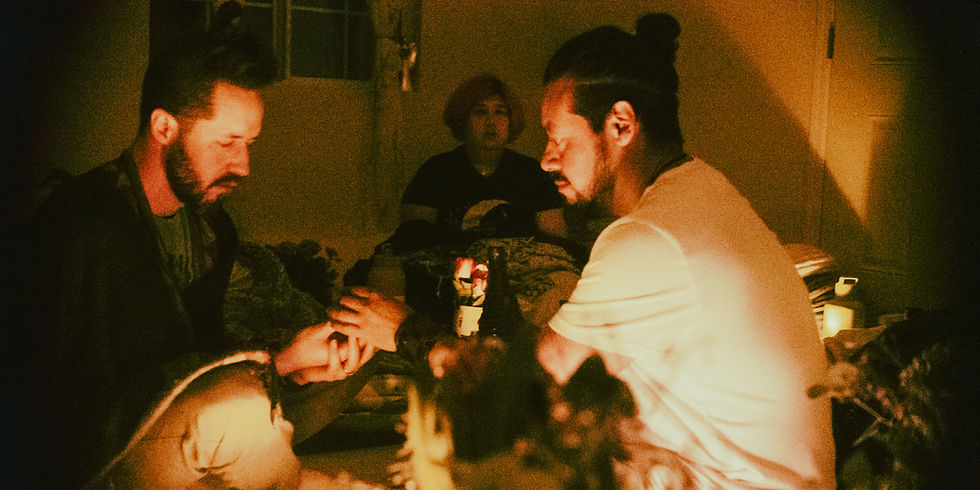
Most people who come to their first ayahuasca ceremony know something is coming. They just don't know what.
They've watched the documentaries. They've read the Reddit threads. Some of them have been building up to this for years. And still, when they arrive at the ceremony space and the night begins, they realize: nothing could have fully prepared them for this.
That's not a warning. That's just the truth of it.
What I can do is tell you what is actually going to happen, what is normal, and what is not. After facilitating hundreds of ceremonies over the past nine years, here is what I tell every first-timer before they drink.
The Night Begins Before the Ceremony Does
When you arrive, we spend time together as a group. Setting intentions. Creating safety. Getting to know one another. This is not filler. This time is the foundation of everything that comes after. The container holds everything. If the container is not solid, the medicine has nowhere to go.
You will set your intention for the night. This is your compass, the question or the wound or the prayer you are carrying into the experience. You don't have to have a perfect answer. You just have to be honest.
Then the medicine is poured.
The First Hour: The Waiting
Most people drink and then wait. The first hour can feel deceptively quiet. Some people feel nothing for 45 minutes. Some people feel it in 20. Either is normal.
What is not normal: trying to force it. Your job in that first hour is to lie still, breathe, stay open, and trust. The medicine is not on your timeline. Sit with that.
You may feel a heaviness in your body first. Or a warmth. Or a subtle shift in how you are perceiving the light and the sounds around you. These are often the first signals that she has arrived.
The Peak: This Is Where the Work Happens

There is no way to predict what you will encounter at peak, and that is the honest answer. What I can tell you is what tends to be true:
The medicine shows you what you need, not necessarily what you want. If you have been carrying grief and running from it, she will put it in your hands and ask you to hold it. If you have been living from a false version of yourself, she will show you the gap between that version and who you actually are.
Visions can be vivid or subtle. Some people see elaborate imagery. Others feel more than they see. Some weep. Some purge. Some laugh. Some do all of this in one hour.
Purging is normal. We do not view it as something going wrong. The body is releasing what it has been holding. If it happens, let it happen.
One thing I tell every participant: whatever arises, breathe into it, not away from it. The moments you most want to escape are usually the moments that hold the most medicine.
The Facilitator's Role (and Yours)
My job during ceremony is to hold the space, not to guide you where I think you should go. I am watching. I am present. I am chanting or singing icaros, working with the energy of the room, and staying close to anyone who needs support.
Your job is to stay with your own experience. This is not a social event. It is not the time to check on your neighbor or talk. You go in, and you go deep.
If something feels overwhelming, you can always signal to a facilitator. We will come to you. You are never alone in that room.
Integration Morning: As Important As the Night

The morning after ceremony is part of the ceremony.
We do not rush out. We sit together and share. Some of what came up in the night will be crystal clear. Some will be a fog you will be working with for weeks. Both are normal. Both have value.
What you do in the days and weeks after ceremony determines how much of the medicine actually lands in your life. The visions are the beginning. The work is what comes after.
What Most People Wish They Knew
After sitting with thousands of participants, a few things come up again and again after the first ceremony:
"I didn't know I was allowed to ask for less." You can always tell us before ceremony if you want a smaller dose. First-timers especially. There is no award for the hardest experience. Start where you actually are.
"I didn't expect to love the people in the room so much." There is a particular intimacy that happens when people sit in ceremony together. By morning you often feel like you've known your ceremony siblings for years.
"I wish I had come sooner." Almost everyone says this.
"I'm not sure what happened, but something shifted." You don't have to understand it. You just have to let it work.
Is This Right for You?
If you are called to this work, that call is worth listening to. Not because ayahuasca is magic. Because you are ready for something real, and you know it.
We are here when you are.
If you have questions before committing to ceremony, schedule a discovery call. We will talk through your history, your intentions, and whether this is the right fit for you right now.
Shaman Danny Rojas has facilitates plant medicine ceremonies in Joshua Tree, California. He was initiated into the Q'ero lineage of the Andes in Peru and has sat with thousands of participants over the course of his practice.


Comments